Don’t Kill the Stupid Idea Too Soon
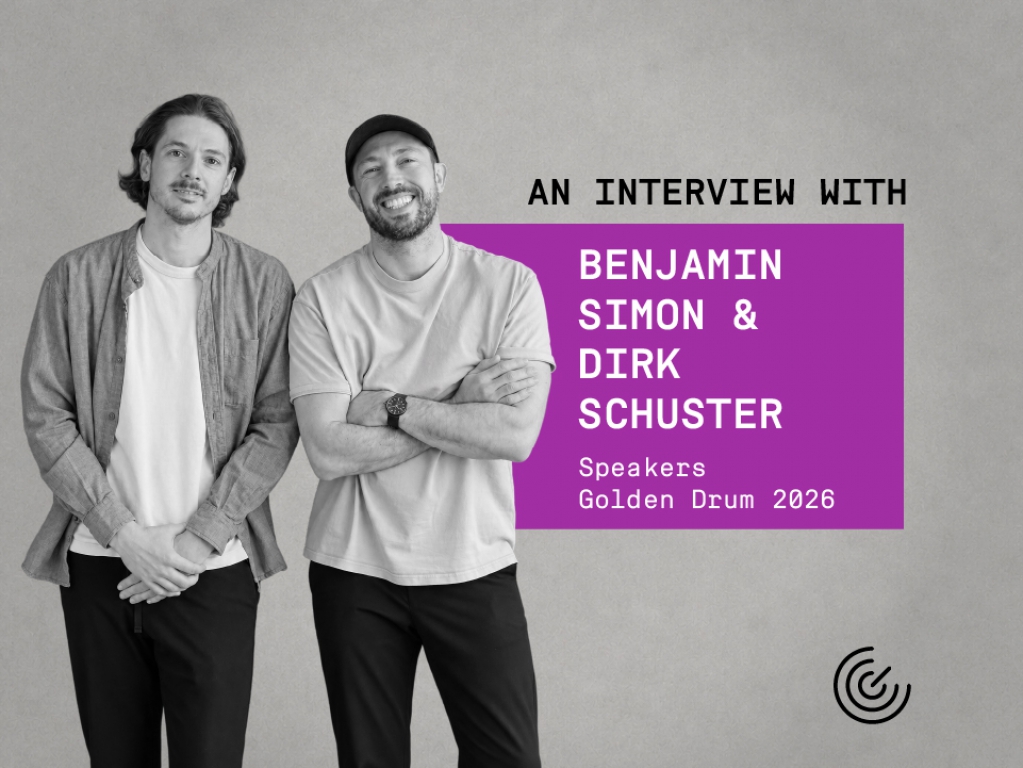
Great ideas rarely arrive fully formed. Sometimes they begin with a rough sketch, a ridiculous thought or something that does not seem particularly promising at all. For Benjamin Simon and Dirk Schuster, Co-Founders and Creative Directors of FOREAL and this year’s Golden Drum speakers, that uncertainty is an essential part of the creative process. For more than a decade, they have grown FOREAL from a two-person illustration studio into an award-winning creative agency working with some of the world’s biggest brands.
Ahead of their Golden Drum session A Pen and a Stupid Idea, they take us behind the polished final work to explore the messy reality of creativity, why beautiful execution alone is no longer enough, and how seemingly stupid ideas can sometimes turn into the ones worth pursuing.
You've been working together for more than a decade. What makes your creative partnership work — and where do you still agree and disagree the most?
We met 20 years ago at vocational school, shared a flat for years, and later ended up at the same studio abroad. So, by the time we founded FOREAL, we had already tested whether we can stand each other, which we'd recommend to anyone considering a business partner.
The biggest advantage by far is that neither of us ever has to make an important decision alone. Not on the creative side, not on the business side. Every call that matters gets talked through with someone who knows the full context and has as much at stake as you do, and that's worth more than being right on your own.
The second thing is that we can be completely honest with each other. Anything can be said, however blunt, and nobody takes it personally. We've never had to phrase things carefully between us, and skipping the diplomatic part saves a remarkable amount of time.
Creative decisions we argue about constantly and loudly, and we always manage to come to a conclusion in the end. The harder ones are the business calls: whether to put another full week into a badly paid pitch because we still think we can turn it around, or whether that's just expensive optimism.
FOREAL started as a two-person illustration studio and has since evolved into a studio working across CGI, animation and visual storytelling. How has your definition of great creative work changed along the way?
In the early years we mostly wanted things to look good. Bold, colourful, detailed, ideally the kind of image you'd want to touch. That was a perfectly fine ambition at the time, because making an image look that good still took real work. What was always in there too, even then, was the twist, something unexpected, ideally with a bit of humour.
Back then we were hired for one illustration, one key visual, maybe a small series of stills, so we could spend days or weeks on a single motif. Today we develop whole toolkits, campaigns and narratives that have to work as motion and hold up across plenty of individual assets. The idea can't live in one frame anymore.
It isn't hard to make things look good anymore either. Beautiful images are free now and they arrive by the second. So the definition moved a little: great work is surprising aesthetics meeting even more surprising storytelling. If there's no thought in it that you didn't see coming, it's just a nice render, and nice renders have stopped being a competitive advantage.
You've described your creative process as a kind of "ping pong," where ideas are passed around and built upon. How do you know when a seemingly stupid or random idea is actually worth pursuing?
We don't. That's the honest answer, and it's also why we just start making instead of discussing.
Ideas in our studio behave like a bouncing ball. Someone says something dumb out loud, someone else sketches it, someone starts building it in 3D, someone doodles over that, and half an hour later it's a different thing entirely. We all sit at one big table, so nobody has to schedule a meeting to say something stupid.
It's not about an idea sounding good. Good-sounding ideas are usually just familiar ones. You can tell there's something in it when people keep picking it up without being asked.
Is there an idea one of you initially thought was terrible that the other managed to turn into something great?
We should probably point out that FOREAL is a lot more than the two of us. Ideas here rarely belong to one person, they get passed around until they turn into something else.
There was a discarded sketch from a commercial project, an asthma inhaler combined with an energy drink. Funny enough as a drawing, but one of us thought it was flat and a bit dumb.
Then someone suggested staging the fake product as a 90s TV commercial. That whole world: rock guitar riffs, an over-the-top voiceover shouted way too fast, hyperactive cuts, dramatic low angles on the product, and one of those disclaimers at the end that nobody could possibly follow. Tim from our team drew an animatic and recorded a dummy voiceover for it, and his voice acting was immediately on point. That turned it into a completely different thing.
It became our most watched reel on Instagram ever, at over 53 million views. The idea wasn't bad, it just wasn't finished yet.
Your Golden Drum talk takes audiences behind the scenes of your creative process. Why do you think it is important to show the messy, unfinished side of creativity rather than only the polished final result?
Because the polished version teaches nobody anything.
Take the inhaler from the previous question. That came out of a batch of over a hundred sketches we made for a commercial project. A handful made it into the final work, the rest went into a folder, and months later one of them turned into the reel we just talked about.
The pile nobody sees isn't waste. It's an archive, and occasionally a gold mine.
The other reason is that portfolios lie by omission. Students look at ours and assume every project is an Instagram project, when a lot of our work is production work under strict guidelines that will never be posted anywhere. Pretending otherwise sets people up to be disappointed by their own careers, which seems like a bad thing to do to someone at the start of one.
From a brand perspective, how can craft and individuality make a piece of communication more distinctive when so many brands are using the same tools, trends and visual language?
Ownable design doesn't come from tools or trends. The same software and the same references in different hands can lead to completely different results. The aesthetic comes from the people making it. Their interpretation, their mindset, their way of approaching a problem, and a taste that took years to develop.
So the most useful thing a brand can do is pick the people whose filter they actually want and then let them do their thing. If you commission a look you've already seen, you get a version of it. If you brief a problem instead, you get something you couldn't have described in advance.
How much should a brand be willing to sacrifice consistency in order to create something that people actually remember?
Less than people think, because consistency isn't the thing standing in the way. Consistency makes a brand recognisable. Predictability makes it invisible. Those are not the same thing, and guidelines rarely distinguish between them.
We've had briefs listing everything we weren't allowed to do, delivered something that broke most of it, and everyone was happy. What the client was protecting wasn't the identity, it was safety.
What's one thing you wish more clients understood about the creative process, and one thing you think agencies could do better in return?
Clients: the last ten percent is where the work actually becomes good, and it's the first thing cut when a schedule tightens. That polish isn't decoration, it's the difference between fine and memorable.
Agencies: come with a problem, not with a finished look. What's happening more and more is that at the stage where a rough sketch belongs, someone shows the client a prompted image instead. And a prompted image doesn't read as a suggestion, it reads as final. All the room for interpretation that should exist at the beginning of a project is gone before the project starts.
The client has fallen in love with a specific look, we're now in the business of reproducing it, and everyone has skipped the part where an idea could still have become something else.
A rough sketch leaves room. That's the whole point of it looking unfinished.
With tighter budgets, shorter timelines and increasing pressure to produce more content, how can agencies protect the time and space needed for genuinely good creative work?
Transparency, mostly. After 13 years, we've stopped panicking when a timeline looks impossible, because the date in a briefing is almost never the real one, it's the comfortable one, with a buffer built in that nobody mentions.
So, we say early on what a certain level of quality actually takes, step by step. Explaining the reasoning turns a schedule from a demand into a shared problem, and shared problems get solved: deliver in stages rather than all at once, add budget and bring in more hands, or simplify the production and find a smarter way to get the idea across.
Clients are far more open to that than most people assume. They just need to hear it before the deadline, not after.
Your seat at Golden Drum is waiting – get your delegate pass and join the creative conversation.